Saturday, October 30, 2010

Sunday, October 24, 2010
Thursday, October 21, 2010
DADA
Lecture last week was over DADA, a movement in art in which I truly am a fan. Dada changed the world, it is what made art what it is today. This is the movement which made people start to appreciate that arts place in the world as more than just a pretty picture and understand that it is and should be at the forefront of the world’s most important issues. Dada changed everything, personally I believe that the praise so often given to the impressionist, cubist etc would be far more deservingly given to the dadist. The other movements are always given credit for asking “what is art” but what did they do really? The movements before Dada and many after focuses on style and that is the bottom line. Dada changed that, Dada focused on ideas. They truly asked what art is, these are the people who created new types of art not just style in which to create it. Collage, abstract typography, assemblage and video art just to name a few. This is the forgotten movement and this is more than just a shame. The reason it is so little known is due to how wide spread it is. It is the only movement of the early 20th century which truly continued till today. You cannot read a paper, a billboard or sign without seeing it. You cannot watch a movie without it being referenced, or go to an art class without aspects of Dada being taught and generally unacknowledged. Dada is the reason art is all around us, the reason we speak and joke and mock and appreciate art and culture the way we do. And it all started by some, mostly forgotten, definitely underappreciated German expatriates in Sweden during WWI.
Crit on 3D project 2
In all I think it went well, most people liked it.
Good points: the craftsmanship was meticulous and orderly, good use of lighting, good choice of display location (other than the small size), form was left up to viewers interpretation, shadows worked well, material became hard to recognize due to way it was used (I think that’s a good thing), nails made a nice border
Bad points: nails were longer than I thought they were so the backer board was punctured and splintered (my crit of the piece), the board looked like a chunk of plywood, the nails took away from the piece (this point came up on both side)
Suggestions made: nail the paper directly to the wall (I hadn’t thought of it and when that was suggested I couldn’t believe I hadn’t, but it would have been an installation piece then and I kind of want it back at some point)
Saturday, October 9, 2010
Oct 8 Lecture
Human form.
The human form has long been a popular choice of subject matter for artists, but in the last hundred and fifty years the way artist approach the human form has changed dramatically. No longer bound to traditional academics, artist around the turn of the century began representing people in a whole new way. Instead of the idealized forms of classic Greek the new art styles tried to show people how they truly were. Now this is not completely new, works such as Da Vinci’s Grotesque series did much the same thing. The difference came in how the subject was represented. Thanks to new art movements such as impressionism artist now painted people in ways that conveyed not only how the person looked but how they felt. With bold uses of color and gnarled ragged line work artist could show dispositions, pain, heartache and despair.
The choice of what to depict also changed. Artist no longer limited themselves to the reclining beauty, they were now free to draw or paint whoever they wanted. This opened a door for such things as the woman’s rights movement who began showing women in new lights. By doing so this forced society to reevaluate the way they viewed certain groups of people.
With so many doors open to the modern artist a layman might think that the artist of today have it easy. Here they would be wrong. With so many outlets explored the budding artists of today find themselves in dire straits. Within all the movements there are genres and subgenres, there are styles and categories never thought of in generations past, there are crossover styles and mediums the question that is posed to artists of today is not what can I do but how best to do it while maintaining that since of me? There are new restrictions in a PC world that were unknown to the artists of the past putting new strains and social boundaries whom most dear not pass. We speak of freedoms allotted to artist of today by those who suffered before but once more we find ourselves in much the same situation. Once more oppressed by governing bodies, once more confined by style and movements, where do we go from here? The simple and superficial answer is wherever we want; the deeper and more ominous one is nowhere.
How did I get to this subject from the one of human form? Simple, take possible the first and defiantly most represented subject matter in art and study it; when you have done so you will have a core sample of art throughout time, with all of its movements, styles, mediums and indeed restrictions and breakthroughs. When you have done so you will see that a pattern emerges. It starts with freedom, at first there were no rules. Then restrictions, limitations by mediums or lack thereof. Then freedom once more, through new mediums such as marble and pigments. New restrictions, by knowledge of point of view, the human makeup and other sciences. Freedom through knowledge, restrictions by the church/by academics. Freedom from the church, restriction by governments. Freedom from governments, restrictions by social standards/explosion of styles and movements/development of technology and questions about what is art and if it even still exists. When all is said and done we find ourselves in much the same place those artists of the 1880 did. Restricted from all corners, with no real answers of where to go and the future of art and even its very existence in the balance.
This may seem off subject but it was the train of thought that I had during class yesterday.
Artists and works
Post Minimalism
Vito Acconci
Blinks 1969: With repetition and similarity this work is well placed on the side of harmony.

Trademark: Hard to define as it is a still from a live performance but taken as a photo the piece works well. The similarity of line and value of the human form makes the work quit harmonious while maintaining tension from the abrupt intersection of line.

Post Minimalism
Sol Lewitt
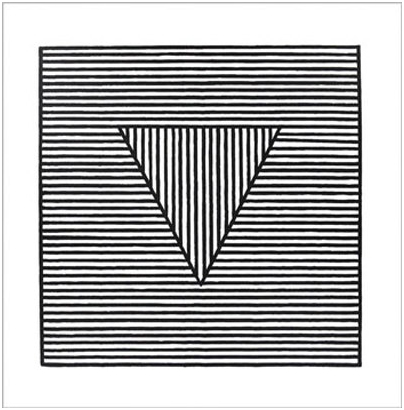
Triangle, .1980: This work is beyond harmonious and sits well in the realm of patterning, yet the placement of the triangle and the direction of line creates a tension in the work in an attempt to not seem boring. Still like most works where pattern is used the attempts failed.
Color Arcs in Four Directions, .1999: Here patterning takes an even more prominent role, yet once again the piece lacks depth and interest is short lived.

Minimalism
Barnett Newman
Adam 1951: While asymmetrical this work is still balanced due to its use of line and repetition of color. A good example of how asymmetry does not always mean chaos.

The World II 1954: Here too the work is asymmetrical yet the balance in not quite as good thus placing it farther towards chaos, but only slightly.

Abstract Expressionism
Mark Rothko
White cloud Over Purple 1957: This work is symmetrical yet its use of clashing color creates a tension so strong that one wants to place it in the chaotic realm.

Number 10 1950: With more complementary colors along with the repetition of line and form this work work is easily defined as harmonious.

Abstract Expressionism
Louise Nevelson
Dream House 1972: Dream House has a strong use of patterning, yet the nature of the piece and the gapping of the pattern place it somewhere between pattern and harmony saving it from the monotony that comes from repeated use of the exact element.

Royal Tide 1960: Not quite a pattern but more of a patterned feel makes up Royal Tide. The repetition of boxes filled with similar items gives the elution of pattern while maintaining interest and identity. Thus this piece fits well into harmony.

Today
Mirrored Birds 2010: Empedocles’ work, in this series, lean heavily on repetition to the point of patterning. Detail and placement is this pieces salvation and what keeps the work interesting.

Concert tabs 2010: Patter in less a part of this work though at first glance it may seem as such. However, this piece is not patterned it is simply a repetition of thyme and subject matter. Thus this work is more harmonious than patterning.

Today
David Kinsey
Unknown Title 2010: This piece might seem chaotic yet due to the abstraction of the subject matter and overlaying imagery yet the use of complimentary colors and repetition of line, form, value, color, subject matter and proper use of placement gives the work a more harmonious quality than a chaotic one.

Unknown Title 2010: Again, we see a work that on the surface may seem chaotic but its truly quite orderly and refined. The use of color, value, form and shape outweigh the varied patterns withing the piece and pull this work back from chaos and deep it the territory of harmony.

Subscribe to:
Posts (Atom)